Spread: My First Spread

Before (not that long ago, really), whenever I read the cards for friends or younger people I knew, one thing I always had to think about was which spread to use: how many cards, where to put them, and what each position means. Personally, that gave me a headache and cut my confidence in the reading a lot.

Normally the basic spread is the 10-card Celtic Cross. But even though it’s basic, it isn’t really standard, because each reader and each school lays it out differently. Thoth lays it out one way, RWS another way, and Thai readers another way again. When someone shows you an example reading, you have to ask about it card by card: which layout, what order (and what each position means, too).

Or even a simple spread like three cards comes in lots of versions, for example:

  • Morning – afternoon – evening
  • Past – present – future
  • Problem – solution – conclusion
  • etc.

All this doesn’t mean these spreads are bad or inaccurate. But I think that holding on too tightly to the positions’ meanings may make us miss some meanings, or some points of view, that the cards are trying to tell us.

So this time I’ll tell you about my own spread, the one I think works for me.

The principles of my spread are roughly these:

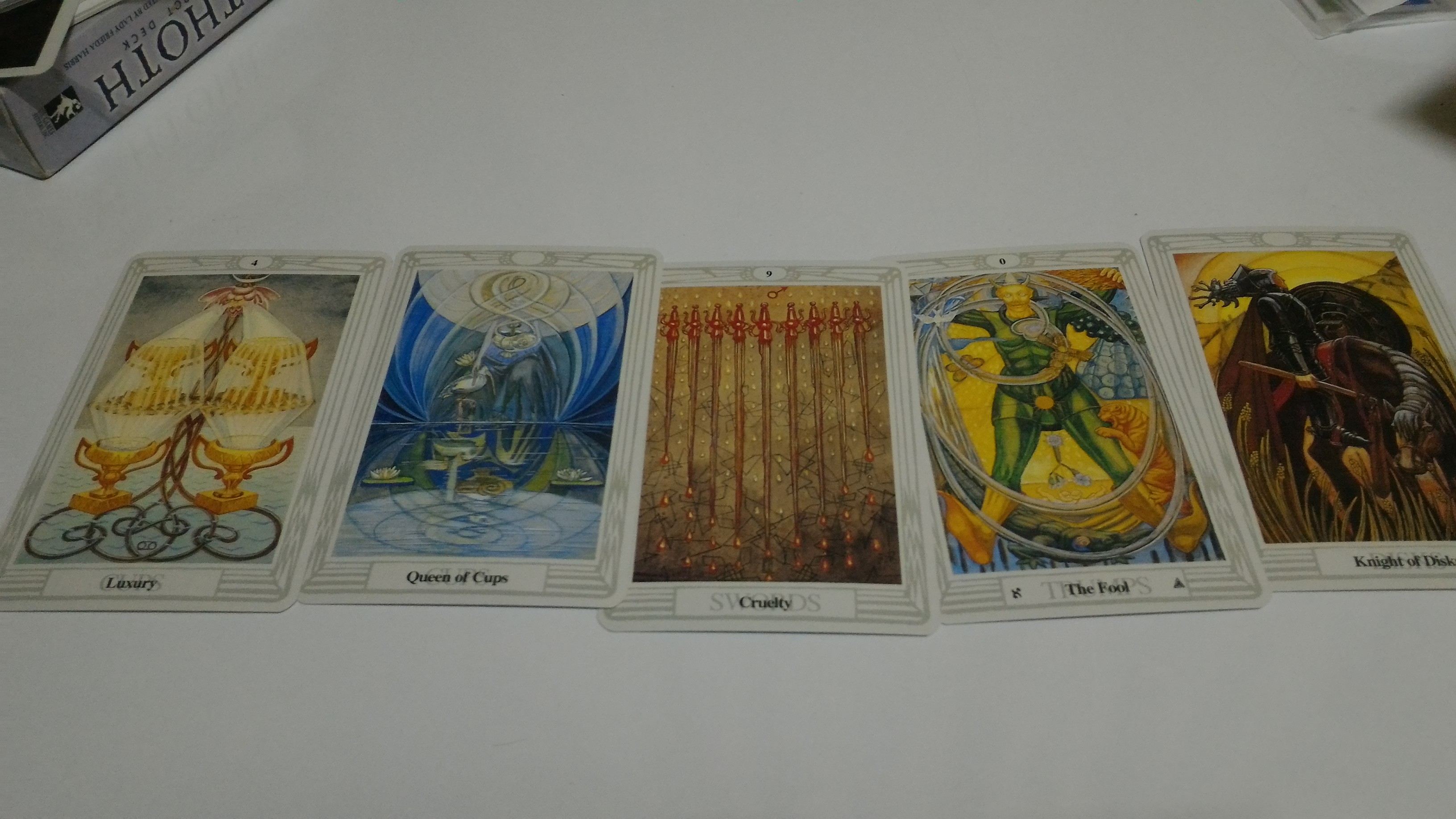
Five Thoth tarot cards in a row: Luxury, Queen of Cups, Cruelty, The Fool and Knight of Disks

  • It uses 5 cards.
  • The first card goes in the middle, and the rest go left and right in turn ([4] [2] [1] [3] [5]).
  • The positions mean:
    • [1]: feelings, thoughts or the current situation
    • [2] [4] [3] [5]: things that affect the current situation, such as things you want to do, obstacles you face, problems in the past, or even choices still waiting for a decision

You’ll notice my spread sets a main meaning for only one card, the middle one [1]. The other cards expand on the first one, and they can expand on it in several ways, for example:

  • If all 4 cards point the same way, they show the surroundings you’re in right now, for example being under pressure or surrounded by problems.
  • If the two sides point in opposite directions, it can show one of two things:
    • Deciding which way to go. [2] [3] are the options to choose from, and [4] [5] are your thoughts about those options, or what may happen if you take each one.
    • The past that affects the present [4][2] and the future you hope for [3][5].
    • To know which case it is, you may need to read the direction of the cards. Sometimes you may need to ask the person you’re reading for which case is closer, so you can read it and find the problem correctly.

In the picture above, while drawing the cards, I asked, “What’s happening with D right now?” (a very open question).

  • [1] Nine of Swords: a feeling of anxiety, stress, being stuck, thinking too hard
  • [4][2] Four of Cups and Queen of Cups: still water. A feeling of stillness, cloudiness, something hidden. What you see may look beautiful, but something seems to be hiding underneath.
  • [3][5] The Fool and Knight of Disks: a feeling of energy, courage, enthusiasm, success, rest
  • The two sides point in opposite directions. The [4][2] side looks still and cloudy, and [3][5] looks energetic and clear.
  • Looking at the direction, from left to right, I can feel an effort to get out of the problem: D doesn’t want to stay in the situation on the left any more, and wants the right side. So the left side is probably past events that affect the present, and the right side is what D hopes for.

Going by the direction, the elements and the mood of the cards, I read it roughly like this:

  • Right now D feels stressed, heavily stressed, and anxious (Nine of Swords), because so far nothing D has done has really succeeded or come to something. D has just been getting through each day to get things done (Four of Cups). Even though plenty of people have come along ready to help, D hasn’t paid them any attention and only cares about themself (Queen of Cups). All D does is hope to get to do whatever they like in the future (The Fool) and finally succeed (Knight of Disks).

When I asked whether it was right, it was fairly accurate (phew…).

It’s still at the testing stage. It may be wrong sometimes and right sometimes, so it takes practice. But if anyone wants to try it, go ahead, and don’t forget to come back and tell me how it went.

Case Study: A Friend Who Feels Their Luck Is Down

What’s interesting about this case is that whenever we’re tired, discouraged, or nothing goes the way we want, and we feel like this without finding the reason, a question tends to come up in our minds: “Is my luck down right now?” “My luck hasn’t been good lately.”

What I think matters most in solving this isn’t how to make your luck better, or which ritual to do to ward off bad luck. What you need to do is find out what’s causing the problem that makes you feel bad, and how you should fix it.

In my view, I think tarot can show us the root of a problem that sits deep inside us. So today I have an interesting case study that should be able to answer a friend of mine, who came to me for help because “I feel like my luck is down, I don’t know why”.

Deck used: Thoth Tarot

How the reading was done: over LINE. I drew the cards for my friend by shuffling twice and taking the top card.

Spread used: Thoth spread
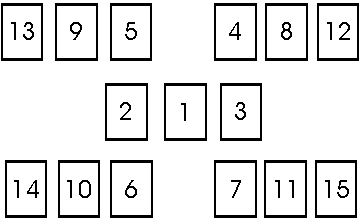
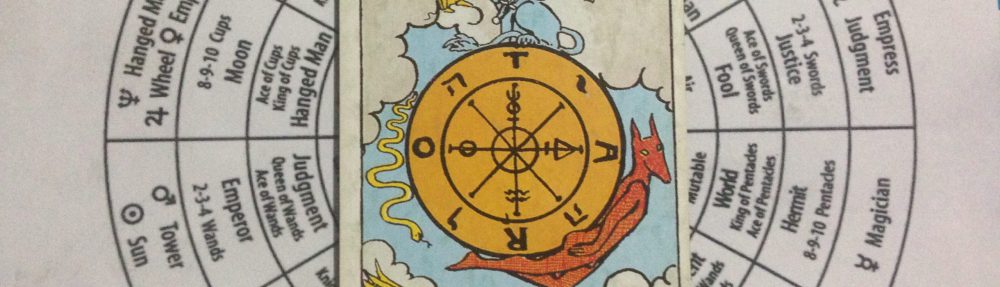
Diagram of the 15-card Thoth spread with numbered positions

Image from www.tryskelion.com

Positions 1 2 3: show the current situation

Positions 13 9 5, 4 8 12: show the trend, what will happen in the future

  • If both sides point the same way, the left side is a follow-on from the right side, or expands on it.
  • If the two sides conflict, the right side is what should happen, and the left side is the way to fix things so the result on the right changes.

Positions 14 10 6: show the root of the problem

Positions 7 11 15: show what can be controlled, what can be fixed, and advice

All right, let’s look at my friend’s cards.
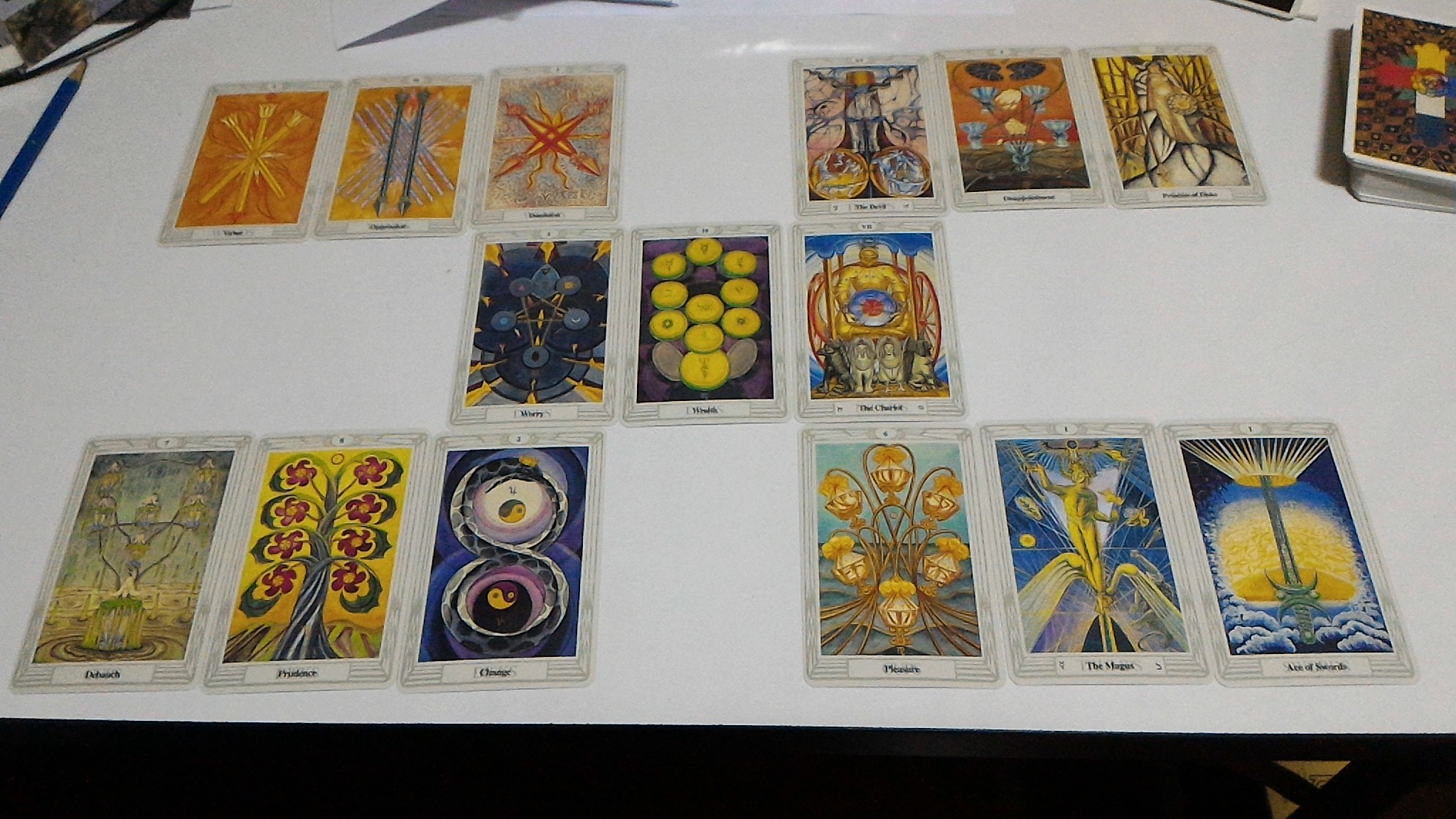
Fifteen Thoth tarot cards laid out in the Thoth spread on a white table

  • Position 1: Ten of Pentacles (10P)
  • Position 2: Five of Pentacles (5P)
  • Position 3: The Chariot (Ch)
  • Position 4: The Devil (De)
  • Position 5: Two of Wands (2W)
  • Position 6: Two of Pentacles (2P)
  • Position 7: Six of Cups (6C)
  • Position 8: Five of Cups (5C)
  • Position 9: Ten of Wands (10W)
  • Position 10: Eight of Pentacles (8P)
  • Position 11: The Magus (Ma)
  • Position 12: Princess of Pentacles (PP)
  • Position 13: Three of Wands (3W)
  • Position 14: Seven of Cups (7C)
  • Position 15: Ace of Swords (1S)

And this is how I read it, before talking with my friend at all (pure imagination at work, really).


Starting with the current situation: right now it looks like the main problem is probably money (lots of money cards came up, 5 of them). That is, there is money (10P) but it can’t be used (5P). They want to travel but can’t really go (Ch). It’s as if there’s a burden, such as debts, or an emergency that this money has to go to (5P), so they can’t use the money the way they want, or do the things they want to do.

The root of the problem: it looks as if there has just been a job change, a house move, or a big change in money (2P), so the money they worked hard to save (8P) had to be used first. But what they paid for wasn’t really worth it. It’s like paying for something with no substance (7C), such as paying a guarantee, a down payment, or signing a contract that doesn’t look very trustworthy, or that they didn’t really want to sign.

Or if it isn’t about money, it may be that at their job they’ve been moved to another position (2P), which makes them uneasy because it’s boring (8P), the work has no goal (7C), nothing they can get hold of, or such a jumble that it gives them a headache, and they feel that both the salary and the position don’t fit (2C).

In short (#1, 2, 3, 6, 10, 14), the unease may be because the money they have isn’t really used for themself, or to follow their dreams, but goes on things they aren’t keen on or don’t get much out of. Or else it’s about a job with no goal, not knowing what it’s for, where neither the position nor the salary fits.

The way to fix it comes in 2 parts

Money:
try talking it over and asking family for help, especially brothers and sisters (6C), to share the load or to be someone to consult and get advice from. But they may have to be the one who takes the lead in solving the problem (Ma). When they talk, they have to be clear about what the burden is and what help they need. No keeping it vague (1S).

Work: try finding extra work, a part-time job or freelance work they’re good at (Ma, 1S), such as teaching English to children (6C), interpreting (Ma), or translating documents in an area they know well.

Result: if they can do this, the situation should get better. They’ll have fire (2W, 3W) and more will to fight. But it may mean a lot of work, or being busier than before (10W), with loads of things to do. Always keep in mind what the goal is. Do just the right amount, let go of what isn’t important, and don’t cling to it.

But if they do nothing, the situation will stay still like this for a long time. Still as in really still, not moving anywhere (5C, PP). The money stays what it is, with no eagerness (De, 5C) or inspiration. So in this period, if something seems interesting, try it. Start with small jobs and grow from there. But don’t take every job that comes along either, until you forget what you wanted to do.


Everything above is what I read from the cards without asking my friend anything at all (pure imagination). After I sent it to my friend to read, I got feedback that the accurate part was work (red is the extra detail my friend told me). This is what I learned:

Work: the job is repetitive, the same thing over and over, boring, with no goal (8P, 7C). So their habits and the way they work changed (2P), like just getting through the day, but if they don’t do it there’s no money (5P), and they won’t be able to go abroad as they planned (Ch). And because the job is boring, it makes them feel that this much is enough, doing this much is fine (10P). They’ve run out of energy to push themself and get their fire going (10W), until they’ve started thinking of giving up their plan to go abroad (2W, 3W).

Advice (6C, Ma, 1S): try pushing yourself by finding what you’re good at and interested in (Ma), things you’ve done before and done well (6C). Set a goal and make it clear (1S).

If they follow the advice: setting a clear goal (1S) will fan the dying fire (10W) back to life and give the plan to go abroad (2W, 3W) more chance of happening.

If they do nothing: they may end up with regrets (5C) and stay at the same workplace, with the same old boredom, needing to work at the same place (De). But they’ll have enough to get by, with what they have or can earn (PP). Maybe not exciting, but it won’t really answer their life goals.

Besides work, there was also the matter of the agent who had gone quiet, with no contact back at all. Looking at the cards, it turns out this was another important thing behind the problem.

The agent: the agent they’re dealing with is a new agent (they’ve just split off on their own (2P)), who may not be trustworthy yet (7C), and the agent’s finances aren’t ready (8P). So my friend is worried about whether they’ll get to go abroad (5P, Ch), even though their own money is already ready (10P).

Advice: my friend (Ma) should change agent (1S) to protect their own rights. And because my friend and the agent know each other (6C), it may be hard to just cancel out of the blue. So giving it a bit more time is probably better than deciding outright.

Result: similar to work.

What I concluded after giving the reading and talking with my friend: it can get to the root of the problem faster and more to the point, especially the agent, which was very important. If we hadn’t talked directly, I might not have been able to connect things to it.

Other interesting things I noticed

  • This time, the two sets of cards that show the trend conflicted completely. The left side is very heavy on Fire, while the right side leans mainly to Earth and Water (though the Water isn’t very strong, because it’s a 5).
  • The Two of Pentacles is another card that’s hard to read. From its keywords it means change. Without the information from my friend, I wouldn’t have known that the agent they use had just split off on their own.
  • This time I tried adding up the numbers of the cards in each interesting set, for example:
    • The root-of-the-problem positions have 7C + 8P + 2P, which adds up to 17, and 1 + 7 makes 8, which matches the Major Adjustment, which shows correctness, fairness and trustworthiness. That matches the agent’s problem, that they may not be trustworthy enough yet.
    • The future trend on the left side has 3W + 10W + 2W, which makes 15, The Devil: clinging to how things are, which here means clinging to the current job until you forget what you actually want. It’s like a warning: watch yourself carefully, and don’t burn out because the job you’re in is too comfortable.

The most important thing from this reading is that talking with the person who wants the reading makes a big difference to solving the problem they face. As I said at the start, I believe tarot can draw out the feelings or problems inside the person getting the reading. So talking directly with them helps both the person and the tarot reader work together, read together, and solve the person’s problem much more effectively.

As for predicting the future, I think the cards can only give a rough idea (from the cards, probably around December to April). It may come sooner or later than that. That depends on what my friend does and how quickly they can solve the problem.

Because the future can always change, we should deal well with the problems in the present, and a good future will follow on its own.
 

Case Study: What Will the Coming Week Be Like?

Today I have an interesting kind of case. I’ve come across this pattern once before, back when I first started learning the cards. It mixes the cards’ meanings with the relationships between each card’s element in an interesting way.

Usually, I have the person ask their question first, then draw the cards one at a time. Sometimes I use a spread and sometimes I don’t, but in this case I used a spread, where each position means:

  • Position 1: what’s happening now
  • Position 2: the overall picture, the things involved in the week after this
  • Position 3: problems, obstacles, challenges
  • Position 4: how things end up at the end of the week
  • Position 5: other advice


The owner of this case is a younger colleague at work. They drew the cards one at a time, and these are the cards that came out:

Question : What will the week after this be like?

When it was asked: during the Thai New Year holiday (mid-April)

Deck used: Tarot of the New Vision

Five cards from the Tarot of the New Vision on a blue cloth: Four of Swords, The Hierophant, Knight of Swords, Four of Cups and Queen of Pentacles

  • Position 1: Four of Swords
  • Position 2: The Hierophant
  • Position 3: Knight of Swords
  • Position 4: Four of Cups
  • Position 5: Queen of Pentacles

Taking a quick look at the whole spread:

  • Most of the cards feel very still, except card 3, the Knight of Swords, which has movement.
  • The Knight of Swords is hemmed in by as many as 4 still cards. It feels cramped.
  • The elements are mixed (Earth, Water, Air), with no Fire.

Let’s look at the meaning of each position.

  • Position 1: what’s happening now
    • Four of Swords: shows stillness, relaxing, resting after being worn out or after just pushing through obstacles. This past week my colleague was very tired, because there were lots of problems at work, and right now the mood is starting to be “I want a break, I don’t want to deal with work”.
  • Position 2: the overall picture, the things involved in the week after this
    • The Hierophant: what’s likely to happen next week can be read in 2 ways:
      • One is going to do a good deed during the holiday.
      • Two is something at work.
      • The priest card, as I personally read it, is a serious place with rules and order, which would include temples, schools, workplaces and government offices.
    • So I thought that in the time after the reading, they’d probably have to be at work or go to the temple, and then meet the obstacle in position 3.
  • Position 3: problems, obstacles, challenges
    • Knight of Swords: shows rushing energy and aggression. It may mean that in the coming week they’ll run into an obstacle, or a conflict that comes up fast, at work or at the temple. It might be being asked to go and do a good deed when they don’t want to.
  • Position 4: how things end up at the end of the week
    • Four of Cups: shows boredom. In the end, this week goes by a bit boringly, nothing exciting. The obstacle that comes up is only something small, something they’ve met before, been through before, already solved before.
  • Position 5: other advice
    • Queen of Pentacles: this card can be read in 2 ways:
      • One is a person who will have an effect, maybe their mother. As advice for dealing with the obstacle: just go along with what Mom wants. (I only found out later that they had once been made to go and do a good deed together when they didn’t want to.)
      • Two is advice for my colleague themself: don’t worry, you can handle it. You have both the knowledge and the plan to deal with it.

In short, reading the meaning of each position gives us:

  • Next week they may meet a problem or obstacle at work, maybe quite suddenly. But they’ve met this kind of problem before, maybe so often they’re used to it, so there’s no need to worry. They can definitely handle it.
  • The other thing is at home: they may be asked to go and do a good deed together, but they may not want to go, and that could cause some bad feeling. The best way out is to just go along with what the family wants.

Besides reading each position, let’s look at other kinds of relationships, such as numbers and elements.

  • What stands out: the Knight of Swords is in the middle but hemmed in by as many as 4 cards. It shows a wish to get out of the situation they’re in now, which may mean wanting to go on a trip or take a break from work.
  • Numbers: the numbers that appear are 4 and 5
    • 4 shows security, stability and stillness, so still you don’t want to move anywhere
      • Four of Swords: I want a rest now, I want time off work now.
      • Four of Cups: I’m bored now, I don’t want the same things over and over any more.
    • 5 among the Majors is The Hierophant: a feeling of tension, of having to stay inside rules and order.
  • Elements: Air, Water and Earth
    • No Fire may mean no inspiration, no energy for work or for creating anything new. Even though there’s an active Air card, the Knight of Swords, it still lacks the boost from Fire. It shows wanting to rest, wanting to get out, but not having the energy to.
    • Earth – Air – Water:
      • The Knight of Swords is hemmed in by The Hierophant, which is Earth, and the Four of Cups, which is Water.
      • The Hierophant is Earth, which weakens the Knight of Swords because it’s Air. It means wanting to get out, but being stuck with rules and work.
      • The Four of Cups is Water, which doesn’t strengthen the Knight of Swords. So besides not getting to go anywhere, they also have to face boring things.
    • Air – Earth – Air – Water – Earth:
      • And it’s hemmed in by another layer: the Four of Swords and the Queen of Pentacles.
      • The Four of Swords is Air, true, but it doesn’t give the Knight of Swords more strength, because The Hierophant sits between them. It may mean that even though they want a rest and want to go on a trip, they’re still stuck with work.
      • The Queen of Pentacles is Earth, which seals it shut even more and makes the push to break through or solve the problem even harder. It could be read as being stuck with a problem at home, or with not having enough money to go on a trip, or maybe needing to ask this woman for help.

In short, reading the numbers and elements gives us:

  • Right now my colleague really wants a rest and wants to get out, but is stuck with problems on several fronts: work, money, or even the place to go, which may not be quite to their liking (from the Knight of Swords facing the Four of Cups).
  • To solve the problem, deal with what weakens us, which means dealing with The Hierophant, the Earth card. But because it’s a Major, they may not be able to escape it. They have to face it, which means using the rules on leave and swapped days off that they’re entitled to. Once they can take leave, they can go on the trip.


From this reading, you can see that one set of cards can be read in many different ways. But from my colleague’s feedback, the most accurate part was wanting to go on a trip but being stuck because of work, which came from reading the overall picture with the help of numbers and elements. Other things were partly right too, such as the same old problems at work (from reading each position).

From this experience, I learned that I should use the feeling the cards give me first, then dig deeper step by step, maybe one card at a time, or by looking at the overall picture plus the relationships between the cards, especially numbers and elements.

Case Study: Ten of Wands

Predict for husband and wife, and you stain them. Predict on life, and you bring ruin and cut their years short. Predict good or harm for young children, and the astrology teacher forbids it.

What they said in the past still holds today. Whether you’re a real astrologer or a tarot reader, love between husband and wife, children, and above all death are still things you shouldn’t predict. The same goes for taking a reading for someone who is ill or has a very heavy problem.

This case was a younger colleague at work who asked about their grandfather, who was ill at the time, and how things would go. They actually drew 3 cards, but the one that stood out most was the Ten of Wands.

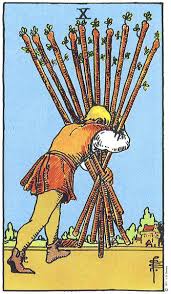
The Ten of Wands card: a figure carrying a heavy bundle of ten wands

My very first thought was a huge burden, as heavy as it gets, about to run out of strength, not knowing when they can put it down. Normally this card isn’t all that negative. It’s more the mood of just feeling tired, feeling weighed down. But when it comes to health, and for someone who is bedridden at that, it’s much worse, like being at the very edge of a coma.

The number 10 shows the end, the last point. The power of Fire has run out completely. There’s no drive left to keep going, and the body and mind are both worn out.

In astrology, it’s also Saturn in Sagittarius. That means hope, progress or recovery is shut down, held back, blocked by Saturn’s power, which makes this card look even more negative.

What I read at the time was starting to run out of strength, starting to be unable to fight on. But at that time there were still the cards next to it, which could turn things a bit more positive, so I gave advice and encouragement.

But in the end, what nobody wanted to happen happened. The one who was saddest was of course the person themself, but the one who was also sad was the one who read the cards for them. Maybe this is why the old saying tells us not to predict on life: how long someone will live, whether they’ll make it. Because in the end, if it does happen, the one who suffers is still the one who said it.

So this was a very important lesson: with fragile matters, it’s better not to take the reading at all, especially life and death like this. Finally, I’d like to offer my deepest condolences to that younger colleague.

Case Study: The Tower

The other day I read the cards for a younger person I know, using a new way of reading that picks and mixes from several schools. Roughly, it goes like this:

  1. The person asking shuffles the cards as much as they like, then cuts the deck as usual. While shuffling, they keep their mind clear and focused.
  2. Then I spread the cards out in a half circle.
  3. The person thinks of a question. How many cards to draw per question depends on what fits. The first time it might be 3 cards, and after that, if they want more detail, they draw 1–2 more at a time.
  4. But if they don’t have a question (which happens a lot!), I do a general reading, and they draw 4 cards:
    1. Card 1, Fire: projects, work that’s about to start, or ideas and creativity that are about to come up
    2. Card 2, Water: love, family, emotions
    3. Card 3, Air: problems, obstacles, communication
    4. Card 4, Earth: money, home, where you live, property


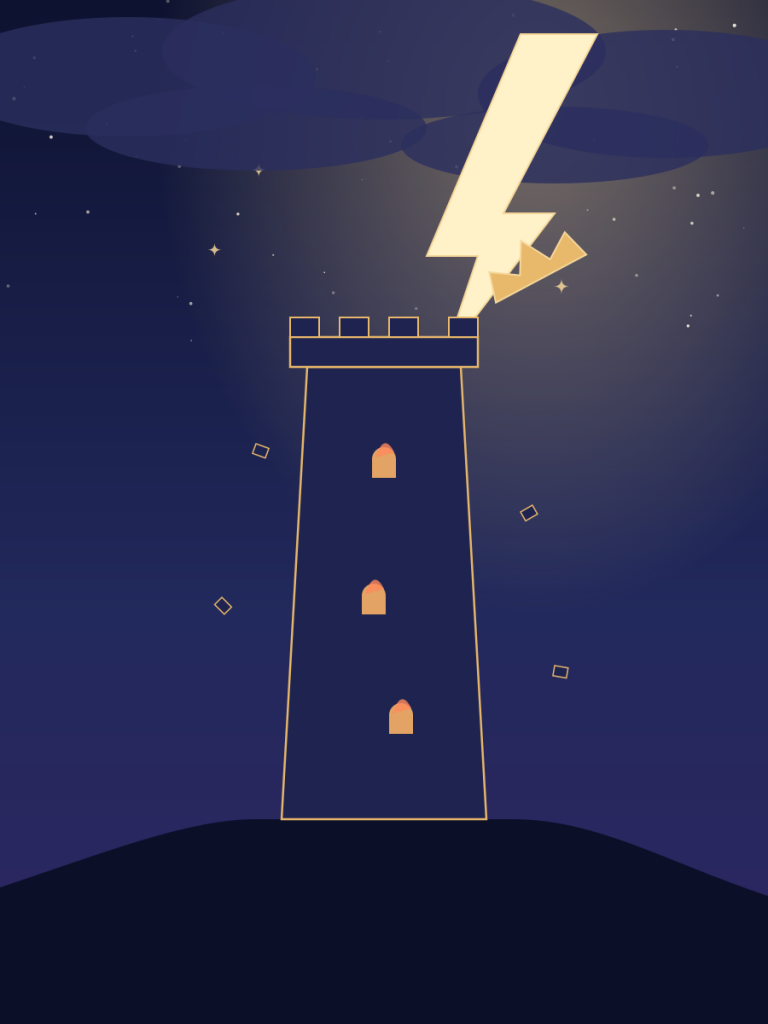
In the example I’m giving today, card 4 (Earth) was The Tower. This is how I read it:A tower struck by lightning, standing for The Tower card

  • There’s probably some renovating, building or moving house.
  • Something happens suddenly that stops the work on the house from going on.
  • Money problems, for example needing money for an emergency (but I didn’t think that was it, because even though Earth stands for money, the picture is a building, so it’s more likely the house).

What was actually happening: the house was being renovated, but the builder couldn’t carry on with the work for legal reasons. That matched what I first thought.


After the reading, today that person came to tell me that bad things had happened: they lost their house keys (physical things, sudden), they were in a car accident (physical things, sudden), and other things happened at home that I hadn’t actually mentioned, because during the reading I had focused more on the problem with the house.

What’s interesting about The Tower

  • The Tower is the card of Mars, which shows force. So something may happen that has an impact on the person asking.
  • Because it’s in the Earth position, what gets hit may be their home, money, land, or even the person themself.
  • Usually The Tower can be read as a clear-out: getting rid of the old and building something new in its place.