Before (not that long ago, really), whenever I read the cards for friends or younger people I knew, one thing I always had to think about was which spread to use: how many cards, where to put them, and what each position means. Personally, that gave me a headache and cut my confidence in the reading a lot.
Normally the basic spread is the 10-card Celtic Cross. But even though it’s basic, it isn’t really standard, because each reader and each school lays it out differently. Thoth lays it out one way, RWS another way, and Thai readers another way again. When someone shows you an example reading, you have to ask about it card by card: which layout, what order (and what each position means, too).
Or even a simple spread like three cards comes in lots of versions, for example:
- Morning – afternoon – evening
- Past – present – future
- Problem – solution – conclusion
- etc.
All this doesn’t mean these spreads are bad or inaccurate. But I think that holding on too tightly to the positions’ meanings may make us miss some meanings, or some points of view, that the cards are trying to tell us.
So this time I’ll tell you about my own spread, the one I think works for me.
The principles of my spread are roughly these:
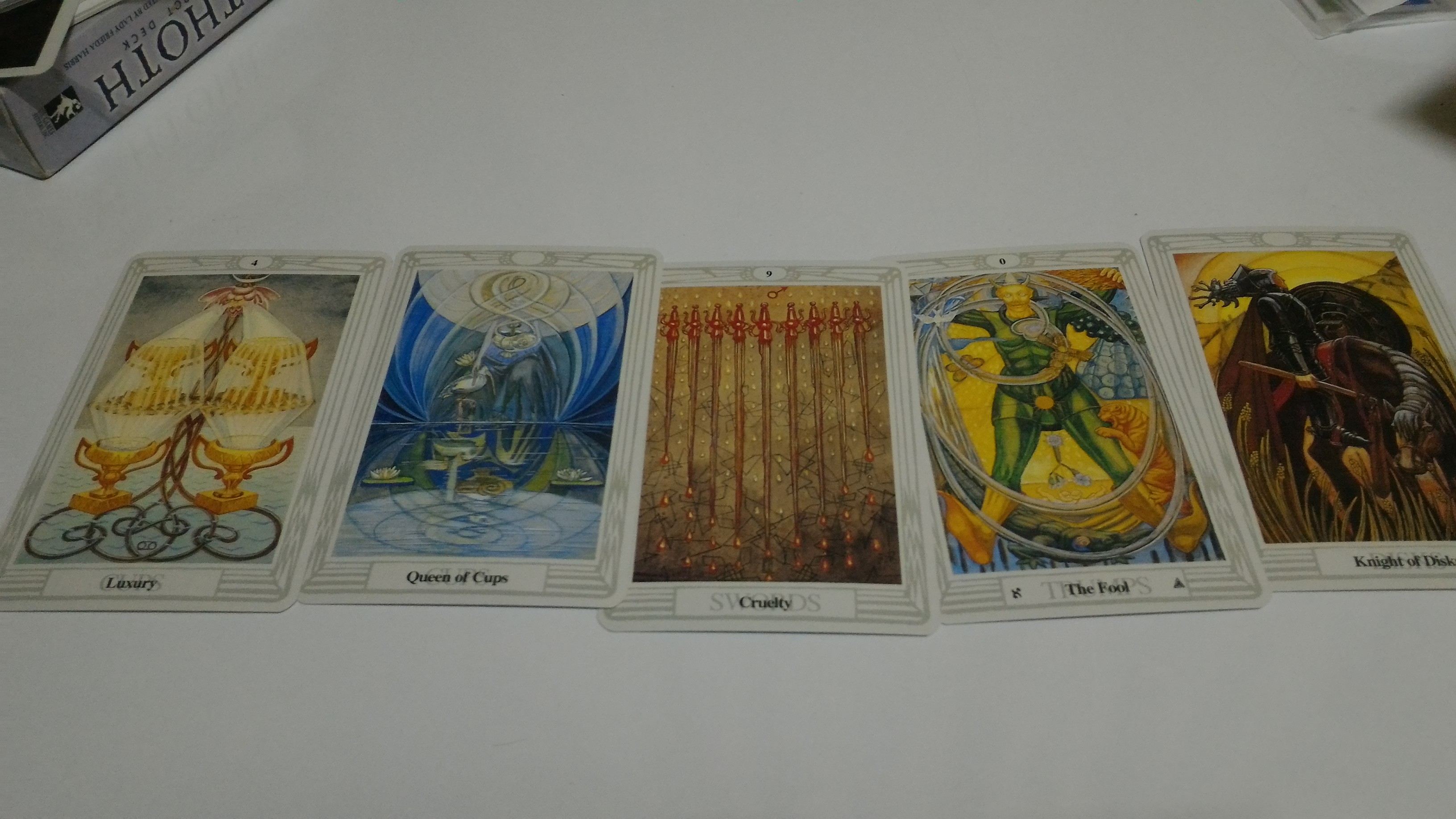
- It uses 5 cards.
- The first card goes in the middle, and the rest go left and right in turn ([4] [2] [1] [3] [5]).
- The positions mean:
- [1]: feelings, thoughts or the current situation
- [2] [4] [3] [5]: things that affect the current situation, such as things you want to do, obstacles you face, problems in the past, or even choices still waiting for a decision
You’ll notice my spread sets a main meaning for only one card, the middle one [1]. The other cards expand on the first one, and they can expand on it in several ways, for example:
- If all 4 cards point the same way, they show the surroundings you’re in right now, for example being under pressure or surrounded by problems.
- If the two sides point in opposite directions, it can show one of two things:
- Deciding which way to go. [2] [3] are the options to choose from, and [4] [5] are your thoughts about those options, or what may happen if you take each one.
- The past that affects the present [4][2] and the future you hope for [3][5].
- To know which case it is, you may need to read the direction of the cards. Sometimes you may need to ask the person you’re reading for which case is closer, so you can read it and find the problem correctly.
In the picture above, while drawing the cards, I asked, “What’s happening with D right now?” (a very open question).
- [1] Nine of Swords: a feeling of anxiety, stress, being stuck, thinking too hard
- [4][2] Four of Cups and Queen of Cups: still water. A feeling of stillness, cloudiness, something hidden. What you see may look beautiful, but something seems to be hiding underneath.
- [3][5] The Fool and Knight of Disks: a feeling of energy, courage, enthusiasm, success, rest
- The two sides point in opposite directions. The [4][2] side looks still and cloudy, and [3][5] looks energetic and clear.
- Looking at the direction, from left to right, I can feel an effort to get out of the problem: D doesn’t want to stay in the situation on the left any more, and wants the right side. So the left side is probably past events that affect the present, and the right side is what D hopes for.
Going by the direction, the elements and the mood of the cards, I read it roughly like this:
- Right now D feels stressed, heavily stressed, and anxious (Nine of Swords), because so far nothing D has done has really succeeded or come to something. D has just been getting through each day to get things done (Four of Cups). Even though plenty of people have come along ready to help, D hasn’t paid them any attention and only cares about themself (Queen of Cups). All D does is hope to get to do whatever they like in the future (The Fool) and finally succeed (Knight of Disks).
When I asked whether it was right, it was fairly accurate (phew…).
It’s still at the testing stage. It may be wrong sometimes and right sometimes, so it takes practice. But if anyone wants to try it, go ahead, and don’t forget to come back and tell me how it went.