Three of Swords: The Sharpness of Three Swords

The Three of Swords looks painful just from the picture on the card, and its meaning is every bit as painful.
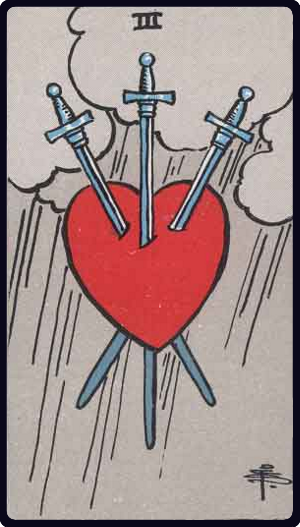
The Three of Swords card: a red heart pierced by three swords, with rain clouds behind it

In love, friendship and work, it mostly comes out on the negative side, especially when it comes to broken promises, betrayal, slander, or being hurt emotionally.

The mood around you isn’t bright either. Whatever you do, your mind feels clouded, nothing feels fresh, you feel withered, and you’re uneasy all the time.

This card can also point to surgery, or accidents involving sharp objects. If it comes up, you need to be a bit more careful as you go about your life.

Even so, this is a Swords card, and swords mostly stand for thoughts, which are something you can’t touch.

When the Three of Swords appears, it means that thoughts, or things you’ve had doubts about, start to take shape and show their outline more clearly. A suspicion that might once have been only a rumor starts to come true. Something other people had planned starts to become real. It’s just what the card shows: the three swords work together, and the element of Air, which usually drifts along freely, gathers into a dark cloud.

Huge black storm clouds covering the evening sky, with sunlight breaking through at their edges

In terms of planets and signs, this card is Saturn in Libra. It speaks of unfairness, balance being held back, and doing good without getting good back.

But in the end, a thought is just a thought. It isn’t a physical object that can come and hurt us. What it does best is hurt the heart (sometimes, getting hit with a real sword would probably be better).

When this card appears, the best thing to do is not to rush to pull the swords, or the thoughts, out of ourselves. Don’t rush like someone who has just been stabbed with a knife and pulls it straight out. That doesn’t really help, and sometimes it makes things even worse.

What we should do is gather ourselves and let our thoughts slowly settle. Look at the situation from many angles, then fix the problem one point at a time. That’s probably the better way.

So when you feel swords starting to pierce your heart, don’t struggle or do anything in a hurry just yet. Think slowly, weigh things up, and slowly pull the thoughts, the bad things, out one sword at a time. Of course, that wound to your heart may not go anywhere. But the dark sky behind it is sure to fade away one day.
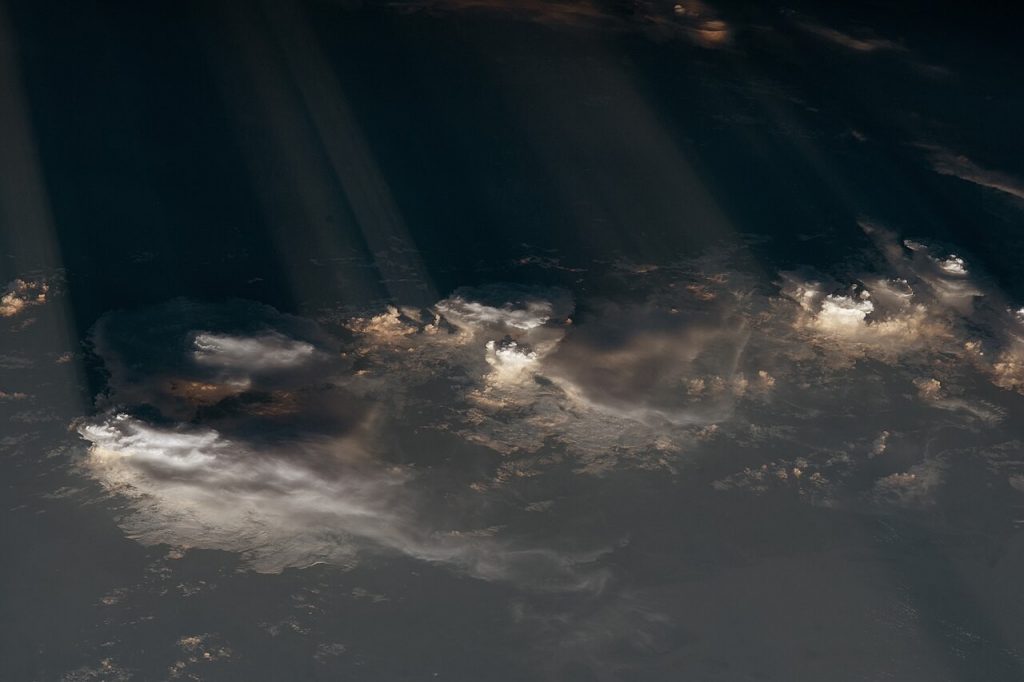
Rays of sunlight shining through storm clouds, photographed from the International Space Station

Tarot and Love

The most-asked question

Questions about love are some of the most asked. They’re in the top three of what most people want to know when they come for a reading. That’s nothing strange: sometimes we want to know where the love we have (or don’t have yet) is heading.

A glowing heart among the starsMost of the questions are the usual ones. When will I meet my soulmate? What will they look like? How sincere is the person I’m seeing? Will we get married? Sometimes it spreads to a third person: Do they have a side fling? What does that person think about my partner? Will my partner get back together with their ex? There can be many more than these, depending on where the person asking stands.
So what kind of question should you ask?

I once read an article from abroad with one line that stayed with me: don’t use the cards as a spy to read other people’s minds. I agree with it.

A good question about love is one whose answer you can use yourself. It isn’t for digging up things to catch the other person out. In my opinion that’s not much use, and on top of that it just leads to misunderstandings for nothing.

Good questions about love go something like this:

      • How do I see love right now?
      • What can I do in this relationship?
      • What do I need to improve to fix the problem?
      • What I expect, and what is actually true right now

These questions are all about you, so you can use the answers to make your love life better.

What do they think of me?

Asking about a third person is quite hard to read in the cards, and the answer is sometimes not much use. Sometimes it only sends your mind spinning more (especially when the answer isn’t a good one).

I don’t really like this kind of question. The main reason is that the third person has their own thoughts, and so many other things affect them that the answer can be way off. Most important of all, however accurate the answer is, we can’t make it work on them 100%.

For example, say you ask, “Will my partner get back together with their ex?” Suppose the answer is no. You still can’t be 100% sure they won’t. You can’t force either of them to follow the answer you got, and there’s a lot about them you can’t control, like their friends or their parents.

The question to ask in this case is, “What should I do so that my partner doesn’t go back to their ex?” That answer is more useful, because you can use it to take charge of the situation.

Does a bad card mean we have to break up?

A cracked heart with golden light shining through the crack

It’s normal for bad cards to turn up sometimes, but that doesn’t always mean the card is telling you to break up (or that your heart will be broken).

In many cases, a bad card is a warning before things get worse. What we should think about is what we’ll do if it happens. Drawing more cards, or looking at the meaning from another angle, helps us find a better answer.

So if you ever meet a reader whose love readings are all negative (an affair, a breakup, arguments, physical fights), know that every card has another side, one they may not have mentioned.

To sum up

Love is your own business (if you’re single), the business of two people (if you’re in a couple), and sometimes other people’s business (if you’re the third person). When you ask about love, what matters is how useful the answer is to you. A good answer guides you so you can solve the problem. A bad answer leaves you anxious and suspicious. Choose which kind you want, but remember that every card has another side. Look for it, and you may find your answer.

The Emperor: The King and His Foundations

The Emperor is card number 4 in the tarot deck. In general, it means power and rule. As a person, it’s someone powerful, who has a role and the authority to make decisions or control things. As a job, it would have to be a soldier, a police officer or a boss, all the way up to a company owner.

The symbols on the card all support the meaning of experience and power very well: the long beard shows experience, and the orb and the scepter show the powers he holds in his hands. But one thing popped into my head that I found quite interesting: the meaning of the number 4.

The number 4 is usually the number of foundations and stability. Especially if we picture a square, or a square shape, we feel even more stability. When we want to build anything, a square shape is probably what a lot of people like to use, maybe because it’s easier to extend, add to and decorate than other shapes.

So what does that have to do with this very experienced king?

The Emperor card standing among colorful building blocks

A king who can build a city and rule it for a long time has to have a firm, strong foundation, built in a shape that looks stable. If an important foundation used an odd shape, like a pyramid or a sphere, it would be hard to build on it or let others build on top of it. Those foundations might be trust, the power in his hands, or even wealth.

But what about us, small people like us who don’t have to rule anyone? What can this card teach us?

The usual advice might be to use the power you have and make full use of your experience to solve problems. But I see another angle: foundations.

Whatever you do for a long-term goal, your foundation has to be good, so you can keep building on it without end. Sometimes we think we already know something, so we don’t give it much attention. That’s neglecting to build a good foundation. It’s like laying marbles as the floor of your house. You can use it, but what else could you build or put on top of it?

Going back over the basics and adjusting them often matters too. It’s like packing down the soil you’ve laid so it gets even firmer. But if we neglect it and pay it no attention, it’s no different from soil that has dried out and left hollows, like the ground under a sidewalk.

So when this card comes up, before you use any power you hold to solve a problem, first check how solid the base of the mountain you’re sitting on really is.

The Empress: A Mother and Her Babies (Mangoes)

Every year, the mango tree behind my house bears fruit, and every year, the one who looks after its flowers and fruit is my mother. She gets up before dawn to water the trees. Once the fruit starts to grow, she keeps trimming the branches and stems so the growing mangoes turn out as big and tasty as they can be. When a branch has so much fruit that it bends down, my mother even goes to the trouble of climbing the tree to tie it up with rope. It’s a picture of care and tenderness if ever there was one.

But there’s another side that people may not see or know about: my mother is very possessive of those mangoes. When she shares them with anyone, she thinks it over again and again, and she has to pick out the nice ones to keep. So hardly anyone around here gets to eat them, and dozens of mangoes are left sitting in the basket in the kitchen.

Seeing what my mother does with the mangoes made me think of card number 3 in the tarot: The Empress.

The Empress card in front of green mangoes in a basket

The Empress is card number 3, and 3 mostly means creating, producing, or even giving birth. Add the picture on the card, which shows abundance and the gentleness of the woman in it, and there’s no doubt that this card can stand for a mother who is loving, caring, self-sacrificing and truly giving.

But every card has two sides. This card looks good, but it has another side too (like my mother).

The Golden Dawn linked this card with Venus. On the good side, that can mean beauty and harmony, with everything looking good. But the other side is being infatuated with the things you have made yourself. If The Empress’s love goes too far, it turns into love that wants to possess, loving too much, until it can sometimes affect other people.

Loving and caring for what we’ve made with our own hands, and sometimes being protective of it, is right and natural. But wouldn’t it be better to share our work so other people can enjoy it too? Who knows, we might find out that those people love and admire our work, or even us, as well.

Wouldn’t it be better if what we make is loved by other people too, instead of us admiring it on our own?

Come to think of it, I’d better sneak off, pick some mangoes and hand them out to the neighbors…

The High Priestess: The Story Behind the Curtain

The Moon has many strange and puzzling stories, but all of them are interesting and worth exploring. Sometimes the Moon doesn’t just light up the night or move the tides. Sometimes the Moon gives us some strange ideas too.

One strange thing about the Moon is that it never turns its other side towards Earth. All the time the Moon is shining (or reflecting the Sun’s light, if you like), we always see the pattern that looks like a rabbit. However many months or years go by, it stays the same. It’s as if it deliberately shows us only its front and tries to hide something behind it. Of course, plenty of people have imagined there’s a colony hidden on the back of the Moon.

The phases of the Moon from new to full, always turning the same face towards Earth

But as time went on, people on Earth got the chance to explore this puzzling world more closely, and found out that there’s no colony and no mystery on the other side of the Moon, only empty ground with no pattern at all.

The far side of the Moon, covered in craters

The far side of the Moon

The High Priestess is the same. The Golden Dawn linked the Moon with this card. If we look closely at the card, we can see how the Moon and the picture match: the woman on the card sits in front of a curtain that seems to be hiding something behind it. Like the Moon, she shows, or reveals, only what she wants us to see. There’s still a mystery hidden inside.

The High Priestess card lying on a book page about the Moon
Who knows what’s hidden back there? Some people might think of a treasure, a body of knowledge, or maybe the keys that can answer all the questions in the universe.

But sometimes there may be nothing hidden there at all…

So when this card appears, it may mean mystery, a riddle, something unclear or uncertain. At work, everything may seem still, but it feels like something is hidden. In love, things may be unclear, so you quietly wonder whether something is going on. Wondering about these unclear things makes us feel emotionally sensitive and unsettled, just as the Moon keeps moving the water on Earth up and down.

So what we should do is not guess at, or hope for, what’s hidden behind those doubts. Instead, we should stay mindful, keep our emotions from being controlled by the uncertainty, and be ready to face the truth whenever it shows itself (whether or not it turns out the way we hoped).

In the end, there may be nothing hidden behind the curtain at all. The same goes for the bamboo grove.

A path through a bamboo forest

The Magician: Dare to Show How Good You (Look)

Magicians always manage to surprise us. Sometimes they conjure things out of thin air, sometimes they make things disappear, as if they can control everything, from small objects to the thoughts and minds of the audience.

Being a magician so skilled that it looks like real magic isn’t easy. It isn’t only about techniques with objects. A magician also needs techniques for controlling people’s minds.

If we look at the card, we can see our Magician standing in front of a wand, a sword, a cup and a pentacle, which means control of the four elements. To put it more clearly, he can control spirit, thought, emotion and material things extremely well.

The Magician card standing in front of books on a shelf

So there’s no denying that The Magician shows someone with knowledge and ability who likes to show it off for everyone to see. He’s the front-row type who dares to think and dares to show it, and he stands out while he’s at it.

But as we know, a magician doesn’t have magic. He shows us that he has it. That’s why The Magician sometimes gets a not-so-good meaning, and has a bit of a reputation as a con artist. That’s the meaning at its most negative extreme (if the Seven of Swords and The Devil are there too, that’s exactly it).

So when The Magician comes up to give you advice, I’d have to say: show other people how good you are (or, show other people so they believe how good you look).

Number 11: The Conflict Hidden in Balance

Number 11 in the tarot: if it’s an RWS deck, everyone knows it’s Justice, the card of justice, of what’s right, and even of balance. If you look closely, where the RWS puts this card is quite special. When we lay out the Major cards from 1 to 21, card 11 sits exactly in the middle. It really lives up to its name as the card of balance.

Rider-Waite-Smith Major Arcana cards laid out in rows, with Justice (XI) in the middle

But there’s one deck that orders them differently: the Thoth Tarot. Its card of balance isn’t number 11, it’s number 8. The man who created this deck (Aleister Crowley) had quite deep reasons for moving this card (and they make sense!!), and they tie in with a lot of other things. I’ll tell you about them in a later post.

But looked at from another angle, Thoth’s balance card at number 8 still has balance in it. For example, the number 8 is symmetrical in itself. Or, if we split the Major cards into three vertical columns, card 8 heads the second column, the middle one, and acts like the pivot of a pair of scales between the other two columns. You can see it this way too.

Thoth Major Arcana cards laid out in three columns, with card VIII at the head of the middle column

Besides this troublesome card 11, I’ve personally come across other problems to do with balance too, not only card 11. The examples below are just things I wonder about myself, from what I’ve studied and picked up.

The first is how the planets are assigned to the cards. If you put them in order (going by the RWS), you get:

  • Mercury, Moon, Venus, Jupiter, Mars, Sun, Saturn

But if the planets were assigned to the cards according to real astrology, the order of the planets should follow the Chaldean Order, which is:

  • Saturn, Jupiter, Mars, Sun, Venus, Mercury, Moon

Then again, the planets were assigned partly from the pictures on the cards and from the Hebrew letters assigned to them too.

Another interesting one is the balance of good cards and bad cards. It may not be about the meanings as such, but about the mood of the cards. If you look carefully, you’ll see that Swords have quite a lot more negative meanings than the other suits.

There are many more conflicts and nagging problems I still wonder about. But I can’t quite say why cards that hide these conflicts are so charming, and why they make us feel they blend together and fit. Maybe these small conflicts are helping to balance the tarot.

The Hanged Man and a Story of Sacrifice

The other day I got the chance to give blood. It was my third time, after not giving any for 10 whole years, so I hardly knew how to prepare. At first, part of me was scared and didn’t want to go, but part of me wanted to give, because it had been such a long time, and it was also a chance to do a good deed in the month I was born.

Speaking of giving blood, around the start of the month I drew cards to see the trend for this September, what events or advice it might bring. And the card that came up for the first week was very interesting: The Hanged Man.

Usually The Hanged Man doesn’t feel like a very good card. Just looking at the picture is uncomfortable. But even though he’s hanging upside down, his face stays calm, with no sign of pain. It could mean it’s time to keep still and stay with your own thoughts for a while, and to learn to look at things from new angles.

Another interesting meaning is that you may have to sacrifice yourself. That’s the interesting part, and it matched me going to give blood exactly.

Thinking about it further, I also found that The Hanged Man is a Water card. Water should really mean emotions and love, but I think it can also stand for sacrifice, or for donating a liquid like blood.

While I was giving blood, I saw all kinds of people who’d come to donate, from students and office workers to market traders, and even monks. It made me feel good, and made me want to come back and give many more times.

So even though The Hanged Man means sacrifice, this sacrifice didn’t cause any heartache at all. It even made me feel good. So next time you get The Hanged Man, it may sometimes mean donating, or a sacrifice in a good way.

P.S. Besides The Hanged Man, the cards I drew were the Three of Cups, the Six of Pentacles and the Ace of Cups. All of them are fairly good cards, so I think they let me read The Hanged Man in its positive sense.

The Fool as Zero

**** Note: most of this post is my own opinion. If you want to cite it, please check other sources too. ****

The Fool is the very first card (if we go by the Rider-Waite-Smith system). The number given to this card is 0, which, put simply, means nothing, empty.

Usually when The Fool comes up, lots of meanings rush into your head: daring to start, carelessness, being unpredictable. And the picture on the card really does show that kind of behavior (who keeps walking when they’re standing at the edge of a cliff?).

The Fool card from the Rider-Waite-Smith deck

But after studying the cards for a while, I started to think of a lot more things about this card.

Let’s start with the number 0.

What is 0? We probably don’t need math to know that 0 is nothing, no value, empty. As an object, it might be an empty box, a blank sheet of paper or an empty glass, anything that looks bare, with nothing in it for us to see. The Fool is a bit like that: there’s nothing about him you can touch. No sense of self, no feelings, no thoughts, nothing at all….

No sense of self

The Fool drifts a lot. He doesn’t even know what he is or what he wants to be. He has no inspiration and no goals. He just drifts along, wandering on and on, like in the picture.

No feelings

The Fool doesn’t pay much attention to anyone. Maybe that’s because he doesn’t know why he should. So he doesn’t share much feeling with anyone, and his feelings are fairly empty.

No thoughts

The Fool hardly thinks about anything, whether or not it’s something he should think about. He doesn’t even think about whether he’s in danger or taking a risk.

Nothing solid

Even when it comes to belongings, The Fool has almost nothing. The more you look, the more he seems to be someone with nothing at all, from his soul to his possessions. He really is an empty person.

But even though The Fool is a complete 0, so much so that you wonder whether he has anything in his life at all (hahaha), think about 0 again. If you remember, 0 has something special that other numbers don’t: whatever you add to it, you get that same thing back, like 1+0=1. Or when you put something in an empty space, where there was nothing, now there’s an object, something that exists.

So as well as reading The Fool as someone with nothing, we can also read him as someone who is ready to be, ready to feel, ready to think and ready to have anything, because he starts from nothing at all. So whenever The Fool receives something, he becomes it straight away, with no bias mixed in. For example, if we tell The Fool he’s a good person, he’ll think he really is a good person.

But The Fool is ready to be anything not because he has everything. It’s because he has nothing at all that he can take everything in (he doesn’t even have an opinion on whether what he takes in is good or bad, haha).

So what do you do when you turn over The Fool? This card can advise and warn at the same time. It may advise you not to overthink, to keep yourself open and to let go a little. Or it may warn you that right now you’re being careless, too careless, whether in your thinking, your feelings or even your money.

So is The Fool a fool? Maybe not. A madman? Hard to say. What’s certain is that he isn’t anything at all, not even himself. It’s not a bad card, but it’s not so good that you should copy it either.

There’s actually a lot more in my head about The Fool, especially from what I’ve read in Waite’s book and the Golden Dawn. If I remember it, I’ll carry on in Part 2.